Building vs Buying a House in Rwanda: Cost Comparison for 2026

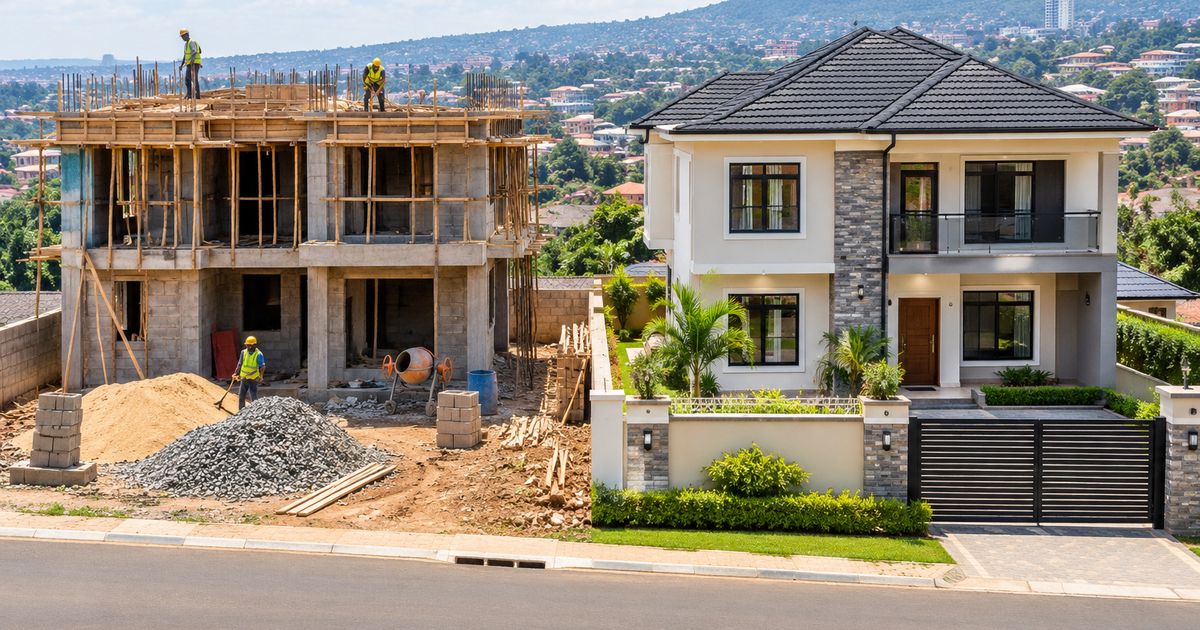
Building vs Buying a House in Rwanda: Cost Comparison 2026
Last updated: September 2026.
Should you build a house or buy one in Rwanda in 2026?
There is no single answer. The cheaper option depends on where you want to live, the size and quality of the house, the cost of land, and how much time you have.
Building can give you more control over the design and budget, while buying can save you the time and uncertainty of managing construction. The important thing is to compare the full cost of both options, not just the construction price or the property’s asking price.
Quick answer. Published construction guides in Rwanda cite roughly RWF 300,000 to 600,000 per square metre, before land, design fees, permits and utility connections. These are indicative figures, not an official estimate. Ready-made 3-bedroom houses in Kigali are listed from about RWF 60 million in entry-level areas to RWF 250 million and above in premium ones. Because land and location drive so much of the total, use the worksheet near the end of this article with your own quotes rather than a single rule of thumb.
Cost to buy
For a 3-bedroom standalone house: roughly RWF 60M to 120M in entry-level areas, RWF 120M to 250M in mid-market areas, and RWF 250M and above in premium neighbourhoods, based on Kwanda listing ranges, not an official average. Add notary fees, registration, any transfer tax, and renovation if the house needs work. Confirm current tax rates with the Rwanda Revenue Authority and your notary. See Kwanda’s full breakdown of how much money you need to buy a house in Kigali for every cost involved.
Cost to build
Construction alone runs roughly RWF 300,000 to 600,000 per square metre, per published Rwandan design and construction guides, spanning basic-finish through premium. Within that range, a 150 sqm house specifically at mid-range quality (roughly RWF 400,000 to 500,000 per sqm) works out to about RWF 60M to 75M in construction, one published guide’s own estimate for that quality tier, not a simple multiplication of the full range. On top of that: land, architectural and engineering fees, the building permit, water and electricity connections, boundary wall and landscaping, and a contingency, commonly cited around 10 percent.
A building permit is required before construction starts. Rwanda’s current online building-permit platform is KUBAKA, which replaced the previous Building Permit Management Information System (BPMIS) in April 2025. Applicants can apply for and track building-permit applications online. Check KUBAKA for the current application process and requirements.
What moves the price most: floor area and number of storeys, the finish level of tiles, fittings and joinery, whether the site needs extra foundation or retaining work, and how many times the design changes once building has started. Finalising the design before construction starts can help reduce costly changes and rework.
Worked example: 150 sqm house, 400 sqm plot
|
Cost line |
Estimate |
Source |
|
Land (400 sqm) |
RWF 48M–65M (emerging area) or RWF 95M–112M (established area) |
Calculated from current Kwanda land listings |
|
Construction (150 sqm) |
RWF 45M–90M |
RWF 300k–600k/sqm, published guides |
|
Design, permit, utilities, external works |
Quote needed |
Varies by project |
|
Land + construction only |
RWF 93M–155M or 140M–202M |
Sum of sourced rows; full cost is higher |
Not an apples-to-apples comparison: this is a 150 sqm house on a 400 sqm plot. Existing houses on the market vary in size, plot, design and finish, so this total should not be read as the cost of an equivalent finished house, and it does not mean building is cheaper.
Worked example: buying a 3-bedroom house
The buying side is simpler, because the seller has already done the building. The cost is the price plus what it takes to complete the purchase and settle in.
|
Cost line |
Estimate |
Source |
|
Purchase price |
RWF 60M–120M (entry-level) or RWF 120M–250M (mid-market); premium properties can be higher |
Kwanda asking-price ranges |
|
Notary, registration, any transfer tax |
Confirm current rates |
Rwanda Revenue Authority, your notary |
|
Renovation, if needed |
Quote needed |
Inspect before you buy |
|
Actual cost |
Purchase price plus every line above |
This is the number to compare |
The true comparison
A construction rate and a house's asking price are not measuring the same thing. The asking price reflects the property as a whole, while the construction rate covers the building itself and excludes land and several other costs. Add the same categories to both sides before comparing: land, finishing quality, transaction costs, financing costs, and unexpected expenses. Once that is done, the gap is often smaller than it first looks, and it can run either way.
If you already own land
This can significantly change the calculation. Building starts from construction, not land purchase: construction + design + permits + utilities + external works + buffer, set against purchase price + transaction costs + renovation + moving for the buy side. Using published rates, construction alone for a 150 sqm house runs roughly RWF 45M to 90M, before the lines that still need a quote. That is the figure to weigh against the price of an existing house in the area where you actually want to live. Confirm the title is clean, using Kwanda’s guide on how to verify land ownership in Rwanda before buying, and check what the zone allows before you build.
Timeline
|
Building |
Buying |
|
Land, design, permits, construction, finishing, move in |
Search, viewings, due diligence, negotiation, transaction, move in |
Buying typically runs weeks to a few months, depending on due diligence, financing and documentation. Building typically runs months, depending on size and site management.
Financing
Building is usually paid in construction-stage payments; buying follows the schedule in the sale agreement. A mortgage or staged loan adds interest and fees on top of the headline figure, so compare current offers with lenders rather than assuming a rate. See Kwanda’s guide on how to get a mortgage in Rwanda for the current process.
Hidden costs to budget for
Beyond the line items already covered, a handful of costs catch people out on both sides. Treat this as a checklist to price for your own case, not a table to copy.
• Utility connections. Water and electricity connections depend on how far the plot sits from existing lines.
• Boundary walls, gates and landscaping. Often an afterthought in a construction budget, these can add a meaningful amount.
• Professional fees. Architect and structural engineer fees for a build, and notary or lawyer fees for a purchase.
• Material transport. On sites with difficult access, common on Kigali hillsides, delivery costs for sand, stone and blocks run higher.
• Temporary accommodation. If you need to move out before a build finishes or a purchase completes, rent during that gap is easy to forget.
• Post-move repairs. A new build can still need a snag list resolved after handover. An older purchase may need repairs not obvious at viewing.
• Insurance during construction. Cover for the site and works in progress is worth pricing in for a longer build.
Advantages and disadvantages
Building
• You choose the design, layout and materials.
• You have more control over where the money goes.
• It takes longer, and you may pay rent elsewhere meanwhile.
• Construction carries risk: delays, quality issues, budget overruns.
Buying
• You can move in sooner and see the finished house before you pay.
• There is no construction to manage.
• You have less say over the design.
• Renovation costs or hidden problems can appear after you buy.
Does location change the answer?
Often more than the building cost does. Based on recent Kwanda land listings, a 400 sqm plot can range from roughly RWF 48M in more peri-urban or emerging areas to around RWF 112M or more in established urban areas, depending on the location and listing. Prime areas can be substantially higher still, and pricing there is better confirmed with a specific valuation than estimated from a range. See Kwanda’s guide on land reference price versus market value in Rwanda for why the official government reference price is not the same as what a plot actually sells for. Land outside central Kigali can cost meaningfully less, but check road access and how far water and electricity have to be brought before treating that saving as real. If you already own land, or want a fully developed neighbourhood where vacant plots are scarce, that can significantly change the calculation. Check zoning, using Kwanda’s Kigali residential zoning guide, and verify the title before committing either way.
When might each suit you?
Building: you already own land, want a specific design, can wait, and can manage the project.
Buying: you need to move soon, found the right property, want no construction to manage, and want more certainty on the total.
Questions to ask before you decide
• Do I already own land, and what is my full budget, including costs beyond the price or build?
• Where do I want to live, and how quickly do I need to move?
• Can I manage construction, or afford someone who can?
• Have I priced unexpected costs, and compared several real listings?
Worksheet
|
Cost line |
Build (RWF) |
Buy (RWF) |
|
Land / Purchase price |
________ |
________ |
|
Construction / Transaction costs |
________ |
________ |
|
Fees, connections, external works / Renovation |
________ |
________ |
|
Buffer + moving |
________ |
________ |
|
Total |
________ |
________ |
FAQ
Is it cheaper to build or buy in Rwanda?
It depends on land, location, size and finish. Construction runs roughly RWF 300,000 to 600,000/sqm, per published guides. Ready-made 3-bedroom houses list from about RWF 60M to 250M+, based on Kwanda asking-price listings, not an official market average. The ranges overlap, so compare real quotes.
Do I need a permit to build in Kigali?
Yes. Building permits are handled through Rwanda’s online KUBAKA platform. Check the current requirements and application process before starting construction.
Does the construction rate include land?
No. Per-square-metre rates cover the building only; land, fees and connections are separate.
How much does it cost to build a 3-bedroom house in Kigali?
For a 150 sqm house, construction alone works out to roughly RWF 45M to 90M at published rates. Land, design fees, permits, connections and external works come on top, and your own plan may differ in size.
Does financing change the total cost?
Yes. A mortgage or a staged construction loan adds interest and fees on top of the headline figure. Compare current offers from lenders rather than assuming a rate, since terms vary by bank and by your circumstances.
How Kwanda can help
Whether you are building on your own land or buying an existing property, Kwanda Real Estate can help you evaluate options against your budget. Browse listings, or WhatsApp us at +250 788 370 360.
Educational only, not financial, legal or construction advice. Sources: DC Studios, FDG Africa, Kwanda listing data, Ministry of Infrastructure (MININFRA) and RISA on the KUBAKA building-permit platform. Get written quotes and confirm current regulatory requirements before you commit.